With our new site going live, we have transferred all of our blog posts and other content to our live site. To continue reading blog posts by USA Kilts, Please visit our blog page on our live site:
Click HERE to view our current live blog
Thursday, October 30, 2014
Our New Website is Live
We hope you like our new and improved website. There were 4 main reasons why we redid it:
1. To better show off the quality of our goods - All of our products are made in the UK, US, and Ireland. We're pretty darn proud of that fact. The quality of goods we offer is objectively higher than the quality of other items in the 'lower end' of the market. We aim to highlight that quality by showing more detailed shots of products (like we do on our homepage banners). This will take time (replacing all of our photos), but we'll get there!
2. We put videos in their place - We have created a few dozen videos of Rocky explaining the difference between products, talking about product attributes and just giving overall tips to kilt wearers. We took those videos and put them on the appropriate product pages, right under the main pictures to highlight them better. We hope you find them useful!
3. We improved the speed of our package pages - Our old "package builder" system was functional, but very slow. We've revamped the way we approach packages and made it a "stepped process". This speeds up the page load times and gives us huge flexibility in the number of products we can offer in each package! Check out the new package pages!
4. We are now mobile friendly - Surfing on your phone and tablet has become the norm for many people. At USA Kilts, we want to stay on the leading edge of technology, so we've redone our website while constantly asking one question: How will this change affect mobile users? While we still have a few kinks to work out on mobile and tablets, we think the new responsive site is a HUGE improvement over our old one. Hopefully you do too!
We're always striving to improve our customer experience. If you have any suggestions on how to improve our site, please let us know!

Tuesday, August 12, 2014
How to get dressed in a kilt
Have you ever wondered how to put on a full kilt outfit? Have you looked cross-eyed and wondered how to tie those shoes with the laces up the leg?
USA Kilts made a video on how to get dressed in a kilt, head to toe. To watch it, click below (you can make it bigger by clicking in the lower right corner)!
USA Kilts made a video on how to get dressed in a kilt, head to toe. To watch it, click below (you can make it bigger by clicking in the lower right corner)!
Monday, March 17, 2014
Happy St. Patrick's day!
Liam, the newest member of the USA Kilts family, wishes you all a Happy St. Patrick's day and reminds you to be responsible tonight if you're lifting a pint.

Friday, February 14, 2014
Kilted Snowman!
What do you do when you've lost 4.5 production days in a week's time due to snow and ice? You build a snowman! Happy Valentine's Day to all of our customers. Here's hoping this guy isn't around for St. Patrick's day!


Friday, January 31, 2014
Kung hei fat choy!
Kung hei fat choy, friends! In honor of the Chinese New Year holiday today, we're eating Chinese food for lunch and sharing the "Chinese Scottish" tartan on our page. Notes from the Tartan Register on this tartan:
The Chinese Scottish tartan was originally created to signify the special relationship that exists between Scotland and China and between the Scots and the Chinese community in Scotland. The inspiration for this tartan came from Madam Guo Guifang, Chinese Consul General, who once spoke of the unique Scottish tartan as one of the major tourist attractions for the Chinese and suggested the idea of creating a specific tartan for the Chinese people. Designed by Heather Yellowley of the Strathmore Woollen Company of Forfar and facilitated by Angus Council and the Scottish Tartans Authority, the tartan incorporates the colours of the Scottish Saltire together with the red and yellow of the Chinese flag. These are interwoven with green bands to symbolize the great co-operation between Scottish and Chinese botanists in the Botanic Gardens of Edinburgh - home to the world's largest collection of Chinese plants outside China itself. The yellow crosses the red in five places which signifies the five stars of the Chinese Flag, the biggest and brightest being represented by the yellow cross in the middle of the red. The tartan was presented to Madam Guo on 6th April 2006 as part of the Tartan Day Celebrations which took place in the Scottish county of Angus.

For those interested, we CAN make this into a 5 Yard Wool Kilt or Premier 8 Yard kilt.
The Chinese Scottish tartan was originally created to signify the special relationship that exists between Scotland and China and between the Scots and the Chinese community in Scotland. The inspiration for this tartan came from Madam Guo Guifang, Chinese Consul General, who once spoke of the unique Scottish tartan as one of the major tourist attractions for the Chinese and suggested the idea of creating a specific tartan for the Chinese people. Designed by Heather Yellowley of the Strathmore Woollen Company of Forfar and facilitated by Angus Council and the Scottish Tartans Authority, the tartan incorporates the colours of the Scottish Saltire together with the red and yellow of the Chinese flag. These are interwoven with green bands to symbolize the great co-operation between Scottish and Chinese botanists in the Botanic Gardens of Edinburgh - home to the world's largest collection of Chinese plants outside China itself. The yellow crosses the red in five places which signifies the five stars of the Chinese Flag, the biggest and brightest being represented by the yellow cross in the middle of the red. The tartan was presented to Madam Guo on 6th April 2006 as part of the Tartan Day Celebrations which took place in the Scottish county of Angus.
For those interested, we CAN make this into a 5 Yard Wool Kilt or Premier 8 Yard kilt.
Tuesday, January 21, 2014

Friday, January 3, 2014
Funny Comic
I saw this on FB today and had to share it on our blog:

Hope everyone has a great weekend!

Hope everyone has a great weekend!
Thursday, January 2, 2014
GREAT Deal on Ex Rental Kilts!
OK, so here's the deal. USA Kilts started a rental program 2 years ago, using 3 of our tartans: Sterling, American Heritage and Celtic Nations. Over the course of the 2 years of renting kilts and packages, we've learned a few things.
1. The Sterling tartan is the tartan that rents 9 times out of 10 b/c the colors are neutral. American Heritage and Celtic Nations don't rent nearly as well.
2. We don't like doing rentals!
With that said, we are going to eventually get out of the rental business (in the next year or two), but we have to whittle down the rental kilt inventory first. Below are the 2 tartans we will be selling and the sizes / quantities of each kilt. Each kilt has slightly longer than average leather straps which accommodate a 5" waist span. There are NO RETURNS on these kilts, so be sure to measure before ordering.
Ideally, we would like to sell these kilts en mass to a new pipe band looking to outfit everyone (with a few kilts to spare) OR to an existing band who wants to change their tartan. We're offering a GREAT deal on kilts that were very lightly used (several have NEVER been rented), though we will sell these to individuals as well. These kilts are ALL 8 Yard Wool kilts, made in Scotland.
Prices:
For 1 kilt, the price is $350 per 8 yard kilt.
For 6 kilts or more, the price is $290 per kilt.
If you're a pipe band looking to clear us out of EVERY size of one of these 2 patterns, the kilts are $230 each (and we'll throw in the kilt hangers).
Shipping will be charged at cost (and is free to orders of 20 or more kilts)
American Heritage:

American Heritage Sizes available -
(Quantity available) Waist size range X Length
(1) 25" - 30" X 23"
(1) 28" - 33" X 23"
(2) 28" - 33" X 24"
(1) 31" - 36" X 23"
(2) 31" - 36" X 24"
(1) 31" - 36" X 25"
(1) 34" - 39" X 23"
(4) 34" - 39" X 24"
(1) 34" - 39" X 25"
(1) 37" - 42" X 23"
(4) 37" - 42" X 24"
(1) 37" - 42" X 25"
(1) 40" - 45" X 23"
(5) 40" - 45" X 24"
(1) 40" - 45" X 25"
(1) 43" - 48" X 23"
(3) 43" - 48" X 24"
(1) 43" - 48" X 25"
(3) 46" - 51" X 24"
(3) 49" - 54" X 24"
(2) 52" - 57" X 24"
(2) 55" - 60" X 24"
Celtic Nations:

Celtic Nations Sizes available -
(Quantity available) Waist size range X Length
(1) 25" - 30" X 23"
(1) 28" - 33" X 23"
(2) 28" - 33" X 24"
(1) 31" - 36" X 23"
(2) 31" - 36" X 24"
(1) 31" - 36" X 25"
(1) 34" - 39" X 23"
(4) 34" - 39" X 24"
(1) 34" - 39" X 25"
(1) 37" - 42" X 23"
(4) 37" - 42" X 24"
(1) 37" - 42" X 25"
(1) 40" - 45" X 23"
(4) 40" - 45" X 24"
(1) 40" - 45" X 25"
(1) 43" - 48" X 23"
(3) 43" - 48" X 24"
(1) 43" - 48" X 25"
(3) 46" - 51" X 24"
(3) 49" - 54" X 24"
(2) 52" - 57" X 24"
(2) 55" - 60" X 24"
Please email me (Rocky@USAKilts.com) for an enquiry OR you can call the shop: 610.948.4110
IF YOU KNOW ANY PIPE BANDS who are potentially looking for a new tartan, please pass this info along by linking them to this page! These tartans WILL STILL be available in the future for additional kilts down the road.
1. The Sterling tartan is the tartan that rents 9 times out of 10 b/c the colors are neutral. American Heritage and Celtic Nations don't rent nearly as well.
2. We don't like doing rentals!
With that said, we are going to eventually get out of the rental business (in the next year or two), but we have to whittle down the rental kilt inventory first. Below are the 2 tartans we will be selling and the sizes / quantities of each kilt. Each kilt has slightly longer than average leather straps which accommodate a 5" waist span. There are NO RETURNS on these kilts, so be sure to measure before ordering.
Ideally, we would like to sell these kilts en mass to a new pipe band looking to outfit everyone (with a few kilts to spare) OR to an existing band who wants to change their tartan. We're offering a GREAT deal on kilts that were very lightly used (several have NEVER been rented), though we will sell these to individuals as well. These kilts are ALL 8 Yard Wool kilts, made in Scotland.
Prices:
For 1 kilt, the price is $350 per 8 yard kilt.
For 6 kilts or more, the price is $290 per kilt.
If you're a pipe band looking to clear us out of EVERY size of one of these 2 patterns, the kilts are $230 each (and we'll throw in the kilt hangers).
Shipping will be charged at cost (and is free to orders of 20 or more kilts)
American Heritage:

American Heritage Sizes available -
(Quantity available) Waist size range X Length
(1) 25" - 30" X 23"
(1) 28" - 33" X 23"
(2) 28" - 33" X 24"
(1) 31" - 36" X 23"
(2) 31" - 36" X 24"
(1) 31" - 36" X 25"
(1) 34" - 39" X 23"
(4) 34" - 39" X 24"
(1) 34" - 39" X 25"
(1) 37" - 42" X 23"
(4) 37" - 42" X 24"
(1) 37" - 42" X 25"
(1) 40" - 45" X 23"
(5) 40" - 45" X 24"
(1) 40" - 45" X 25"
(1) 43" - 48" X 23"
(3) 43" - 48" X 24"
(1) 43" - 48" X 25"
(3) 46" - 51" X 24"
(3) 49" - 54" X 24"
(2) 52" - 57" X 24"
(2) 55" - 60" X 24"
Celtic Nations:

Celtic Nations Sizes available -
(Quantity available) Waist size range X Length
(1) 25" - 30" X 23"
(1) 28" - 33" X 23"
(2) 28" - 33" X 24"
(1) 31" - 36" X 23"
(2) 31" - 36" X 24"
(1) 31" - 36" X 25"
(1) 34" - 39" X 23"
(4) 34" - 39" X 24"
(1) 34" - 39" X 25"
(1) 37" - 42" X 23"
(4) 37" - 42" X 24"
(1) 37" - 42" X 25"
(1) 40" - 45" X 23"
(4) 40" - 45" X 24"
(1) 40" - 45" X 25"
(1) 43" - 48" X 23"
(3) 43" - 48" X 24"
(1) 43" - 48" X 25"
(3) 46" - 51" X 24"
(3) 49" - 54" X 24"
(2) 52" - 57" X 24"
(2) 55" - 60" X 24"
Please email me (Rocky@USAKilts.com) for an enquiry OR you can call the shop: 610.948.4110
IF YOU KNOW ANY PIPE BANDS who are potentially looking for a new tartan, please pass this info along by linking them to this page! These tartans WILL STILL be available in the future for additional kilts down the road.
Monday, December 30, 2013
Custom Sporran Designs
In case anyone was wondering, we CAN have custom sporrans made to spec
(within certain restraints). We don't have the ability to alter shape and come up with a brand new cantle design, but we CAN do
more than just our standard sporrans! If you want to mix and match elements
from sporrans we carry OR you have a specific hide in mind for a sporran
(badger, muskrat, jackolope, bear, raccoon, stag, etc) OR you want your
own personal FF or Police badge on a sporran, we can help!
Below are 3 different, NON stock designs. 2 were for 1 customer who supplied the pewter knot work and the pewter stag head. The other was for a customer who wanted a "non traditional dress sporran" and we helped him come up with this design.

Think outside the box! Email Rocky@USAKilts.com with your ideas and we'll see if we can help!
Below are 3 different, NON stock designs. 2 were for 1 customer who supplied the pewter knot work and the pewter stag head. The other was for a customer who wanted a "non traditional dress sporran" and we helped him come up with this design.

Think outside the box! Email Rocky@USAKilts.com with your ideas and we'll see if we can help!
Thursday, September 26, 2013
Videos now online
We took a long time to do them and an even longer time to complete them, but our videos are now on Youtube!
We took the most common questions we are asked and put the answers out there for all to view. Now you can get even closer to an "in store" experience without ever leaving your chair. We cover topics from "What's the difference between Sett and Stripe" to "how do I tie my ghillie brogues", to "How not to lose a kilt pin." The videos are either educational / tutorial, product guides, or measuring instructions.
Click here for a link to our Youtube channel to view all our videos.
Here is a sampling of a few of our videos.
We took the most common questions we are asked and put the answers out there for all to view. Now you can get even closer to an "in store" experience without ever leaving your chair. We cover topics from "What's the difference between Sett and Stripe" to "how do I tie my ghillie brogues", to "How not to lose a kilt pin." The videos are either educational / tutorial, product guides, or measuring instructions.
Click here for a link to our Youtube channel to view all our videos.
Here is a sampling of a few of our videos.
How to put on a kilt outfit:
Kilt Jacket Styles and when they're worn:
How to wear a sash (for women):
Wednesday, August 7, 2013
Ancient, Modern, Muted, Weathered... What's the difference?
When you look at the
tartans available from the different mills in the UK, you often come across what
appear to be more than one tartan for the same clan or more than one version of
the same tartan. Using the MacDonald Clan tartan as an example, you may see
MacDonald Ancient, MacDonald Modern, MacDonald Muted, and MacDonald Weathered.
Does that mean there are 4 MacDonald Clan tartans? What are the differences
between them?
Strictly speaking, the MacDonald Clan tartan (as shown below) is defined by it's thread count. By thread count, I'm referring to the sequence of colors and the # of threads of each color. When that sequence is stacked up warp and weft (horizontally and vertically as you weave cloth), you have a tartan. For the example of MacDonald, it's thread count is:
/Blue 18, Red 4, Blue 8, Red 10, Blue 25, Red 4, Black 25, Green 25, Red 8, Green 6, Red 4, /Green 18
Below is a picture of the MacDonald tartan, showing that thread count The image was taken from the Scottish Tartans Authority:

The terms Ancient / Modern / Muted / Weathered (aka Reproduction) are color palettes for a tartan. The thread count does not change, but the shades of the colors within the thread count does. This does not make it a different tartan, as only the shades of the color have changed, not the thread count itself. To use a parallel example, take a dark red Chevy Corvette and a bright red Chevy Corvette and put them side by side. So long as the year, make and options are the exact same, they are BOTH identical Corvettes with the same performance, just slightly different colored versions of the same thing.
The same holds true for tartans. Just because the color palette varies slightly doesn't make it a whole new tartan, just a slightly different color version of the same tartan. Below are examples of how the color palettes change for each version:
Ancient - The Ancient color palette is meant to simulate older plant dyes, which would generally come out lighter in color. In the tartan cloth, the following colors (as defined in the tartans' thread count) have the following shades:
Red turns to orange
Blue turns to a light sky blue
Green is a grassy green
Yellow is a pale yellow
Here's an example of the MacDonald Clan tartan in the ANCIENT color palette:

Modern - The Modern color palette is meant to emulate modern, bold colored dyes. These are darker in color and more bold.
Red is a bold red
Blue is a navy blue
Green is a dark bottle green (like a beer bottle)
Yellow is a bold yellow
Here's an example of the MacDonald Clan tartan in the MODERN color palette:

Muted - The muted color palette is meant to emulate soft, natural colors. It falls between the lighter ancient color palette and the darker modern color palette.
Red turns to blood red
Blue is a stormy sky blue
Green is an olive green
Yellow turns to a gold
Here is an example of the MacDonald Clan tartan in the MUTED color palette:

Weathered (aka reproduction) - The Weathered color palette (also known as "Reproduction" by one mill) is meant to look like the tartan has been recovered from a bog and affected by the weather. It uses lots of browns and grays to drive that look home.
Red turns to a "salmon" red
Blue turns to bluish grey
Green becomes brown
Yellow turns to pale gold
Here is an example of the MacDonald Clan tartan in the WEATHERED color palette:

If there's one thing to take away from this article, it's that a tartans thread count (how a tartan is 'defined') doesn't change going from Modern to Ancient to Muted... just the colors within the tartan itself turn different shades of the defined color.
What is your favorite color palette for your clan tartan? CLICK HERE to view the stock tartans offered from all of the Scottish mills and see for yourself the differences between Ancient, Modern, Muted and Weathered for your own tartan.
Strictly speaking, the MacDonald Clan tartan (as shown below) is defined by it's thread count. By thread count, I'm referring to the sequence of colors and the # of threads of each color. When that sequence is stacked up warp and weft (horizontally and vertically as you weave cloth), you have a tartan. For the example of MacDonald, it's thread count is:
/Blue 18, Red 4, Blue 8, Red 10, Blue 25, Red 4, Black 25, Green 25, Red 8, Green 6, Red 4, /Green 18
Below is a picture of the MacDonald tartan, showing that thread count The image was taken from the Scottish Tartans Authority:

The terms Ancient / Modern / Muted / Weathered (aka Reproduction) are color palettes for a tartan. The thread count does not change, but the shades of the colors within the thread count does. This does not make it a different tartan, as only the shades of the color have changed, not the thread count itself. To use a parallel example, take a dark red Chevy Corvette and a bright red Chevy Corvette and put them side by side. So long as the year, make and options are the exact same, they are BOTH identical Corvettes with the same performance, just slightly different colored versions of the same thing.
The same holds true for tartans. Just because the color palette varies slightly doesn't make it a whole new tartan, just a slightly different color version of the same tartan. Below are examples of how the color palettes change for each version:
Ancient - The Ancient color palette is meant to simulate older plant dyes, which would generally come out lighter in color. In the tartan cloth, the following colors (as defined in the tartans' thread count) have the following shades:
Red turns to orange
Blue turns to a light sky blue
Green is a grassy green
Yellow is a pale yellow
Here's an example of the MacDonald Clan tartan in the ANCIENT color palette:

Modern - The Modern color palette is meant to emulate modern, bold colored dyes. These are darker in color and more bold.
Red is a bold red
Blue is a navy blue
Green is a dark bottle green (like a beer bottle)
Yellow is a bold yellow
Here's an example of the MacDonald Clan tartan in the MODERN color palette:

Muted - The muted color palette is meant to emulate soft, natural colors. It falls between the lighter ancient color palette and the darker modern color palette.
Red turns to blood red
Blue is a stormy sky blue
Green is an olive green
Yellow turns to a gold
Here is an example of the MacDonald Clan tartan in the MUTED color palette:

Weathered (aka reproduction) - The Weathered color palette (also known as "Reproduction" by one mill) is meant to look like the tartan has been recovered from a bog and affected by the weather. It uses lots of browns and grays to drive that look home.
Red turns to a "salmon" red
Blue turns to bluish grey
Green becomes brown
Yellow turns to pale gold
Here is an example of the MacDonald Clan tartan in the WEATHERED color palette:

If there's one thing to take away from this article, it's that a tartans thread count (how a tartan is 'defined') doesn't change going from Modern to Ancient to Muted... just the colors within the tartan itself turn different shades of the defined color.
What is your favorite color palette for your clan tartan? CLICK HERE to view the stock tartans offered from all of the Scottish mills and see for yourself the differences between Ancient, Modern, Muted and Weathered for your own tartan.
Saturday, July 20, 2013
How NOT to make a kilt...
A bit of history... Those of you who know me and have heard my 'pitch' may have heard me answer the question (which is asked a LOT), "Which is better... a Hand Sewn kilt or a Machine Sewn kilt?" My answer is ALWAYS, "it depends on the skills of the kiltmaker... I've seen high quality hand sewn kilts and POOR quality hand sewn kilt just like I've seen high quality machine sewn kilts and POOR quality machine sewn kilts".
A while back I repaired (for a pipe band we service) a machine sewn kilt from one of our competitors. It was a poorly made machine sewn kilt as much of the internal bits of the kilt were missing.
Today, a pipe band who uses us for a few items called about bringing in a couple kilts to be repaired and altered. Normally we do not repair other kilt maker's work because we don't know what we'll find (you'll understand why by the end of this post), but since these 2 individuals are existing customers and have purchased multiple kilts from us, we wanted to help them out. Below is an example of a poor quality hand sewn kilt, as brought in by a local band who went with a reasonably inexpensive, local, part time kilt maker (in MD). She isn't new to the trade... her website states that she's been making kilts for 38 years.
I am specifically NOT naming the company used to make this kilt (b/c I don't want to embarrass them in public), but if you'd like to see the signature on the inside of the kilt to verify who I am speaking about, I can email you a picture.
I've often spoken about the quality of thread being an issue when sewing a kilt. I can now show you why. When you use poor quality and reasonably thin cotton thread, it will deteriorate over time. The kilts I repaired today were made in 2008 and 2010. The wool fabric itself was still in FANTASTIC shape (which tells me the kilts weren't abused or excessively dry cleaned to cause premature deterioration of the thread). Here is some of the thread that was pulled from the kilt where the thread had snapped. Notice how fuzzy the thread is and how there are thin spots visible where it would have failed again:

I did do a burn test on this thread. When burned, the smoke was not black, it ashed up and kept burning until I blew it out. It left ashes and not a hard plastic ball. It smelled like smoke and not burning hair, so I determined it to likely be cotton.
Another issue with this particular kilt (which will be compounded by brittle disintegrating thread) is the stitches per inch. A good hand sewn kilt will have 8 to 10 stitches per inch. More stitches per inch = more time it takes to sew. That's the beauty of a machine sewn kilt... you set the stitches per inch by a dial on the machine and it doesn't take any longer or shorter. On a hand sewn kilt, each stitch takes time, and time = money.
This particular kilt has 5 stitches per inch (and I sampled the kilt across 10 pleats with my ruler to get a fair average # of stitches per inch). I used pins to show the location of each stitch, to make it easier to see:

The issue with fewer stitches per inch is that there is more stress ("load") born by each stitch when the body pushes out against the fabric. This is especially true when the canvas lining isn't sewn in (see next section). When you couple the additional stress of fewer stitches with the poor quality thread, you get breaks in the thread. This kilt also doesn't appear to have any "lock stitches", meaning that if a thread fails (breaks), it will pull out to a locked stitch and stop. Here are two pleats that have torn out due to failed stitches:


Here is a stitch that just failed and is starting to come apart:

On top of the thread issue, this kilt also has fusible lining ironed in, instead of horsehair canvas lining sewn in. Fusible lining is used by some large machine sewn kiltmaking companies in Scotland to save time (mass production), but I have NEVER seen it in a hand sewn kilt before. It saves roughly 30 to 40 minutes of labor in the makeup, but over time, the fusing glue comes loose and presto, the internal lining is just 'floating' under the cotton lining, serving no purpose. This puts ALL the stress on the pleat stitches, and when there are only 5 stitches per inch, you get failed stitches (breaks).

You'll also notice in the picture above that the scalloped pleats are not all sewn together (steeked). Well, funny thing... they were steeked, but the thread snapped, leaving 3/4 of them dangling without any reinforcement from steeking stitches or the reinforcement of a horsehair canvas (since the fusible interfacing had come unglued). This contributes to pleat splay and having the depth of each pleat stick down below the bottom of the selvedge.
The stitches holding the bottom of the cotton lining to the wool also failed (again, cheap thread):

The black bar in the above photo covers up the kiltmaker's signature and date (she signs and dates each kilt she makes).
I wanted to hold this kilt up as an example that no matter hand sewn VS. machine sewn, no matter 1 year making kilts VS. 38 years, there are good and bad quality kilts out there. A quality kilt is made up of a combination of ALL of the following:
1. Quality material
2. Quality thread and internal components
3. Skill of the kilt maker
I hope this helps to explain more of what to look for in a kilt and helps to educate a bit about the construction of a proper kilt.
A while back I repaired (for a pipe band we service) a machine sewn kilt from one of our competitors. It was a poorly made machine sewn kilt as much of the internal bits of the kilt were missing.
Today, a pipe band who uses us for a few items called about bringing in a couple kilts to be repaired and altered. Normally we do not repair other kilt maker's work because we don't know what we'll find (you'll understand why by the end of this post), but since these 2 individuals are existing customers and have purchased multiple kilts from us, we wanted to help them out. Below is an example of a poor quality hand sewn kilt, as brought in by a local band who went with a reasonably inexpensive, local, part time kilt maker (in MD). She isn't new to the trade... her website states that she's been making kilts for 38 years.
I am specifically NOT naming the company used to make this kilt (b/c I don't want to embarrass them in public), but if you'd like to see the signature on the inside of the kilt to verify who I am speaking about, I can email you a picture.
I've often spoken about the quality of thread being an issue when sewing a kilt. I can now show you why. When you use poor quality and reasonably thin cotton thread, it will deteriorate over time. The kilts I repaired today were made in 2008 and 2010. The wool fabric itself was still in FANTASTIC shape (which tells me the kilts weren't abused or excessively dry cleaned to cause premature deterioration of the thread). Here is some of the thread that was pulled from the kilt where the thread had snapped. Notice how fuzzy the thread is and how there are thin spots visible where it would have failed again:

I did do a burn test on this thread. When burned, the smoke was not black, it ashed up and kept burning until I blew it out. It left ashes and not a hard plastic ball. It smelled like smoke and not burning hair, so I determined it to likely be cotton.
Another issue with this particular kilt (which will be compounded by brittle disintegrating thread) is the stitches per inch. A good hand sewn kilt will have 8 to 10 stitches per inch. More stitches per inch = more time it takes to sew. That's the beauty of a machine sewn kilt... you set the stitches per inch by a dial on the machine and it doesn't take any longer or shorter. On a hand sewn kilt, each stitch takes time, and time = money.
This particular kilt has 5 stitches per inch (and I sampled the kilt across 10 pleats with my ruler to get a fair average # of stitches per inch). I used pins to show the location of each stitch, to make it easier to see:

The issue with fewer stitches per inch is that there is more stress ("load") born by each stitch when the body pushes out against the fabric. This is especially true when the canvas lining isn't sewn in (see next section). When you couple the additional stress of fewer stitches with the poor quality thread, you get breaks in the thread. This kilt also doesn't appear to have any "lock stitches", meaning that if a thread fails (breaks), it will pull out to a locked stitch and stop. Here are two pleats that have torn out due to failed stitches:


On top of the thread issue, this kilt also has fusible lining ironed in, instead of horsehair canvas lining sewn in. Fusible lining is used by some large machine sewn kiltmaking companies in Scotland to save time (mass production), but I have NEVER seen it in a hand sewn kilt before. It saves roughly 30 to 40 minutes of labor in the makeup, but over time, the fusing glue comes loose and presto, the internal lining is just 'floating' under the cotton lining, serving no purpose. This puts ALL the stress on the pleat stitches, and when there are only 5 stitches per inch, you get failed stitches (breaks).

You'll also notice in the picture above that the scalloped pleats are not all sewn together (steeked). Well, funny thing... they were steeked, but the thread snapped, leaving 3/4 of them dangling without any reinforcement from steeking stitches or the reinforcement of a horsehair canvas (since the fusible interfacing had come unglued). This contributes to pleat splay and having the depth of each pleat stick down below the bottom of the selvedge.
The stitches holding the bottom of the cotton lining to the wool also failed (again, cheap thread):

The black bar in the above photo covers up the kiltmaker's signature and date (she signs and dates each kilt she makes).
I wanted to hold this kilt up as an example that no matter hand sewn VS. machine sewn, no matter 1 year making kilts VS. 38 years, there are good and bad quality kilts out there. A quality kilt is made up of a combination of ALL of the following:
1. Quality material
2. Quality thread and internal components
3. Skill of the kilt maker
I hope this helps to explain more of what to look for in a kilt and helps to educate a bit about the construction of a proper kilt.
Friday, June 28, 2013
.jpg)
Tuesday, June 11, 2013
Care for Summer Fashion That Beats the Heat
Four Things to Remember
When Caring for Your Kilt
Any respectable kilt maker
will explain to a potential customer why it’s important to purchase the best
quality kilt that they can afford. This is because a nicer quality kilt has
more versatility and can be worn in different situations. To draw a parallel,
envision a nice pair of slacks. You could easily get away with pairing them
with a jacket and tie and attending a dressy function. At the same time, you
could also wear them on your daily errands, paired with a polo, and people
wouldn't give it a second glance. However, the inverse is not true. If you are attending a dress function with a
pair of informal cargo shorts or jeans, you’re probably not going to get a
favorable reaction.
The same holds true with a
quality kilt. You’ll get
more use out of your kilt and turn heads for the right reasons. However, in
order to justify an investment like an 8 Yard kilt, you’ll need to learn how to
properly care for it. With the right maintenance and storage practices, there’s
no reason why you can’t enjoy your fine wool kilt for the rest of your life.
The question then begs: What are some things to keep in mind to protect your
investment, so you can get the most mileage out of your
kilt and hand it down to the next generation? Here are some tips to keep in
mind:
• Dry-Clean Your Kilt Only Occasionally and
as a Last Resort: The
solvents dry-cleaners use aren't the best for a wool kilt. That’s because they
remove the wool of its natural oils, making it more brittle over a period of
time. In addition, if they're not familiar with kilts, a poor pressing could
result in the kilt’s pleats looking disheveled. While the kilt should be
pressed every couple of years, it should only be done carefully by hand or by a
trained kilt maker. Talk to your dry-cleaner, and if they haven’t dealt with
kilts before, it might be best to seek other methods.
• You Can Wash Your Kilt But Proceed with
Caution: Most of the
time, you don’t need to completely soak your kilt, but if you feel it’s
necessary, make sure to soak it in cold to lukewarm water – and only for a few
minutes at that. Again, though, this is usually unnecessary unless it’s really
dirty. Dabbing a stain with a cold wet cloth and a drop of Dawn detergent is
usually enough to rid your kilt of it.
If you do soak the kilt, lay it flat to dry.
• Remember to Only Store Your Kilt When It’s
Completely Dry: Let’s say
you were at your local Highland Games, and you experienced a bit of rain
("fine Scottish weather"). Before you store your kilt for the next
occasion, make sure it’s completely dry by laying it flat across the foot of
your bed or back of your sofa. Otherwise, mildew might befriend your kilt, and
nobody wants that. If needed, aim a fan at the kilt to aid in drying.
• Store Your Kilt in the Closet or in a
Drawer: Your kilt can be
hung in a closet, but make sure you protect it with a cloth garment bag to
prevent a moth attack. Moths love wool and will happily procreate, so future
generations can eat holes in your wool kilt as well. Many experts recommend
storing your kilt in a drawer, but make sure to lay it flat and store it with
cedar blocks if possible.
This sounds easy enough,
right? Good! With the right care and thoughtful maintenance, a quality kilt
will be a bargain you will wear for a lifetime and be able to hand down as an
heir loom.
Wednesday, May 22, 2013
How a kilt is made / Why does a kilt cost so much?
We often get asked why a traditional kilt costs so much. They retail for roughly $500, which is a pretty hefty sum to lay down for a single article of clothing for most guys. While sewing a Premier 8 Yard Kilt, we documented several (not all) steps of the process to show our customers and friends what's involved in the construction costs (aside from the high price of wool cloth). An 8 yard kilt takes roughly 18 to 20 hours of labor to complete, soup to nuts and that doesn't account for the wool cloth, the lining, the straps and buckles or the canvas.
The largest block of time is in the sewing of the pleats. Each pleat is meticulously measured using a tiny ruler and then pinned. When the pin comes through the back side, the adjacent pleat must be measured as well. This is how we sew the pleats "inside out" so that you don't see any of the stitching from the outside of the kilt.


Then each pleat is sewn, slowly and in keeping with the curve of the person's body (waist to hip ratio), with reinforcement at the bottom of the fell.


The largest block of time is in the sewing of the pleats. Each pleat is meticulously measured using a tiny ruler and then pinned. When the pin comes through the back side, the adjacent pleat must be measured as well. This is how we sew the pleats "inside out" so that you don't see any of the stitching from the outside of the kilt.
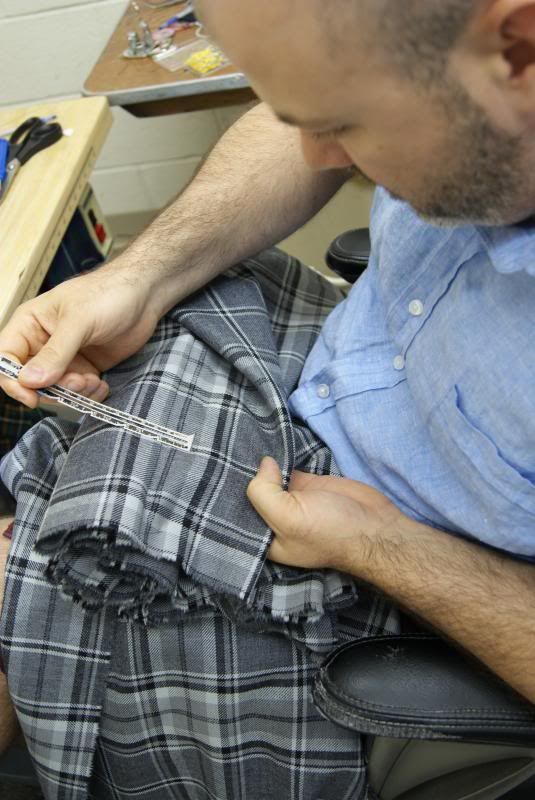
Each pleat is pinned 6 to 10 times down the length of the fell (the sewn down area in the upper portion of the kilt). Measuring and pinning and sewing each pleat takes roughly 8 - 10 minutes per pleat. To give you an idea how long that will take, this kilt has 28 pleats, which means we'll spend about 4 hours (and up to 5 hours if we have to re-do any pleats) sewing the pleats alone.
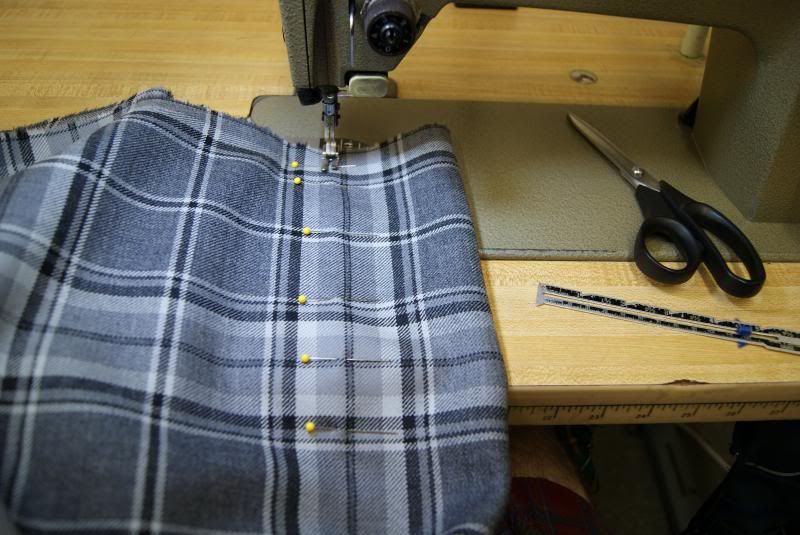
Then each pleat is sewn, slowly and in keeping with the curve of the person's body (waist to hip ratio), with reinforcement at the bottom of the fell.
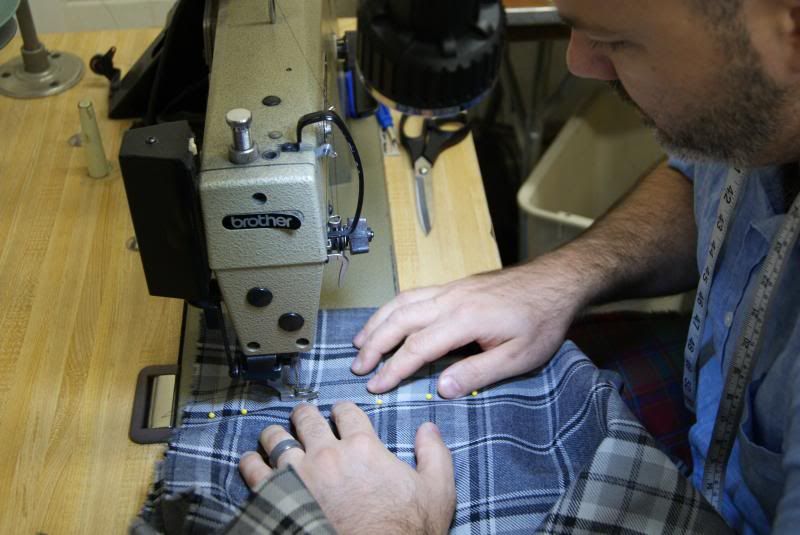
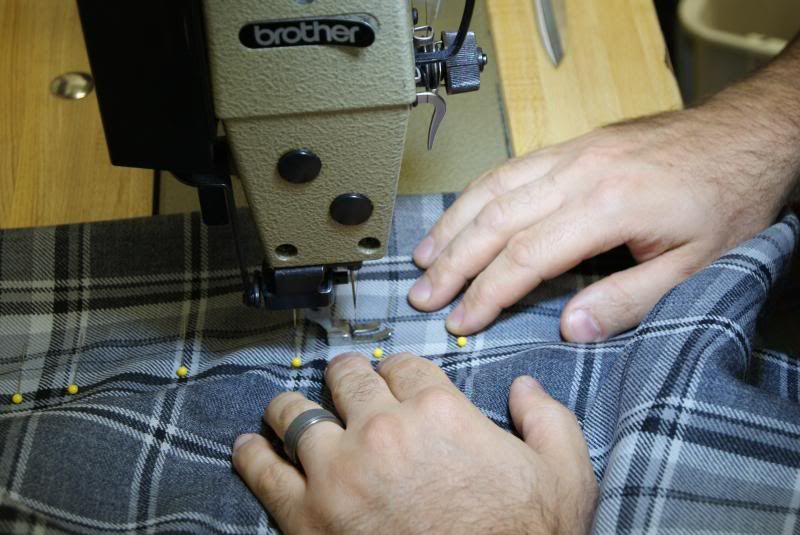
After the pleat is sewn, the pins are removed and the pleat is checked for accuracy and consistency. The horizontal lines of the tartan must be perfectly lined up with no "stair effects" (where one line is higher than the same line on the adjacent pleat). The pinning helps to minimize this, but occasionally we get the "stair effect" for a particular pleat if the fabric twisted while pinning or sewing. At USA Kilts, our tolerance is 1 thread off. If the "stair effect" is 2 threads or more, the pleat must be taken out and re-measured / re-pinned / and re-sewn.
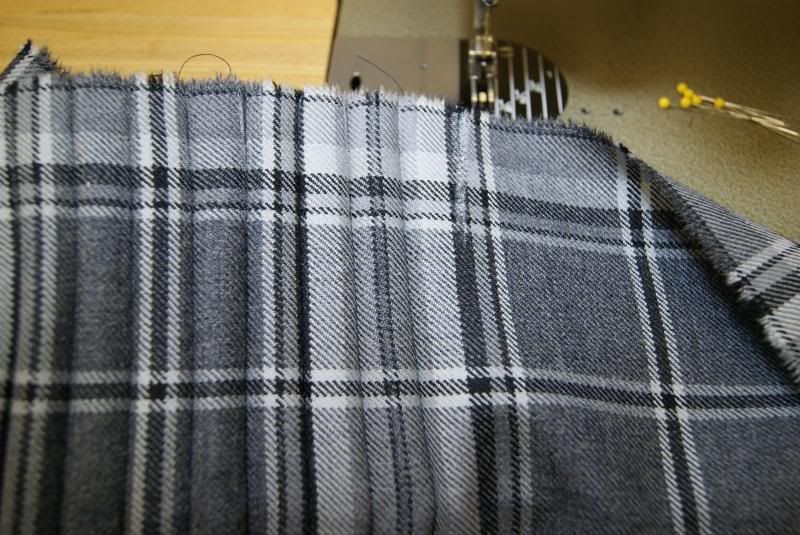
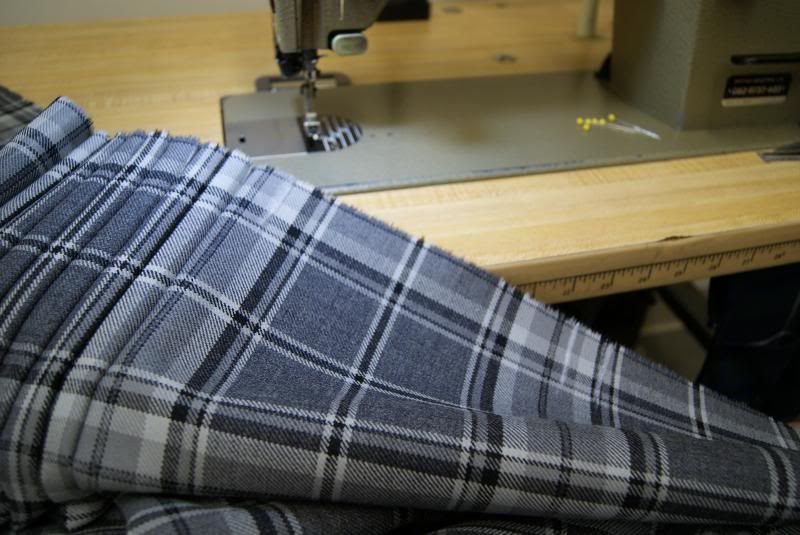
After the pleats are all sewn in and the front and rear aprons are attached, the pleats are pressed flat down the length of the fell and scalloped out. This reduces the bulk in the waistband and makes the kilt more comfortable. It also compromises the structural integrity of the kilt, so the pleats must be steeked across the bottom of the fell to keep them from dipping down below the bottom of the kilt where they aren't supported in the waistband.
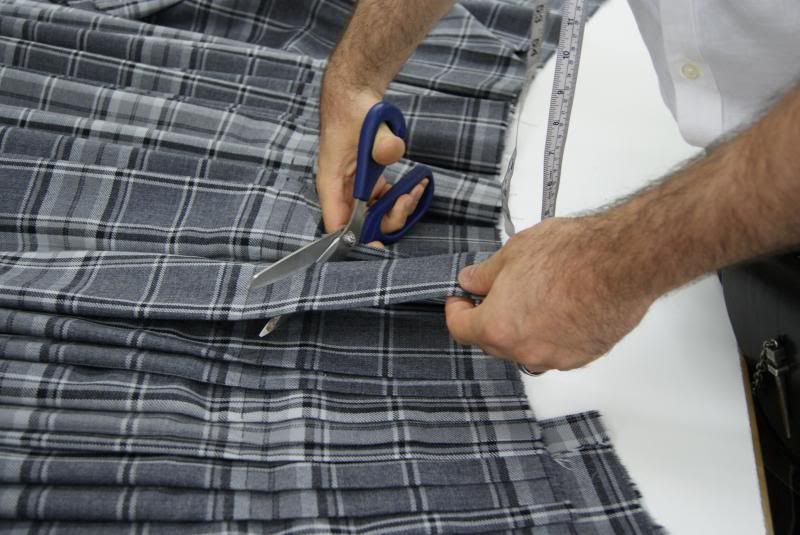
The pleats are steeked (we steek them with a machine to themselves and then we also steek them by hand to each other) to reinforce the structural integrity of the garment. From this point on, pretty much all the sewing is done by hand. It is much more time consuming than using a machine, but must be done by hand to keep the stitches from showing through to the outside of the garment.

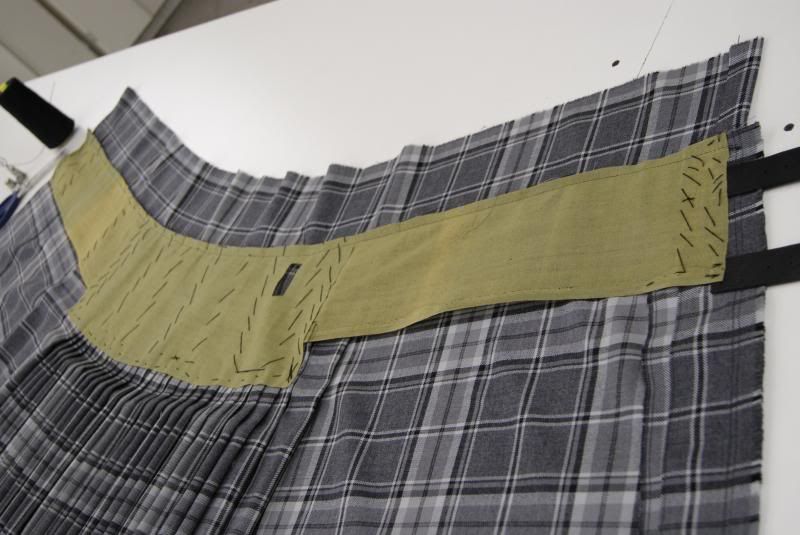
Next we put in a horsehair canvas lining. We sew it into the kilt in 3 pieces... a wider piece across the inside of the pleats (which are now scalloped out) to reinforce the structural integrity of the pleated section and two narrower pieces on each apron. These will provide rigidity of the upper portion of the kilt across the belly and help take the pressure of your body pushing out against the kilt. It helps to minimize or eliminate the wool itself bearing this force and distorting the tartan. This step MUST be done in order to ensure the long life of the garment. Even though you don't really see this step in the finished kilt (and some companies may skip it as it adds time in hand sewing), it is important. We also partially steek the kilt a 3rd time through the horsehair canvas, to help keep the pleat tips up.
Note that the straps on the near side are stitched to the canvas and all 3 pieces are stitched together where the 2 joins are.
Next, the lining is cut out and sewn in. We start with the bottom edge of the under apron and work our way across the bottom of the fell to the front of the kilt. We then work our way up the fringed edge and back across the top.
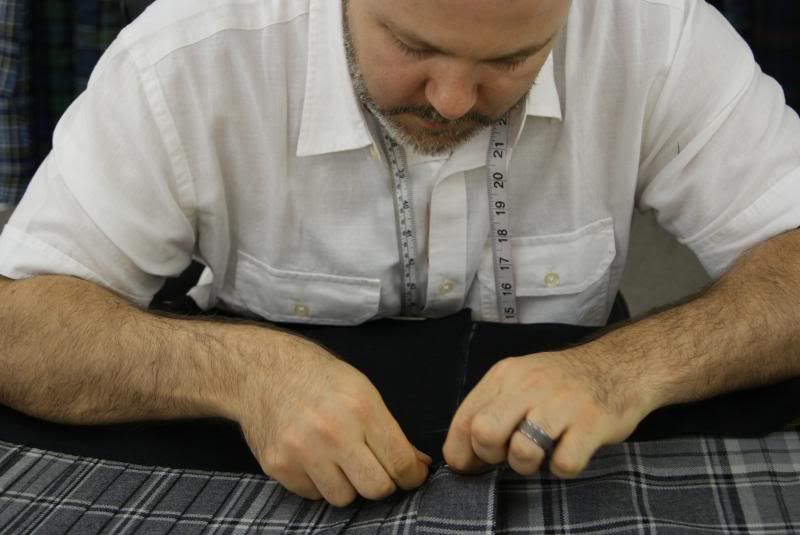
Here is a close up picture of the hand sewing across the bottom of the lining in the pleated section. Each pleat has 3 - 4 stitches stitches on it holding the lining to the wool. This line of stitching also acts as an additional line of steeking. You'll have to look closely as the stitches are pretty small and are black thread on black lining. Ideally, they'll be effectively 'invisible' to the eye.
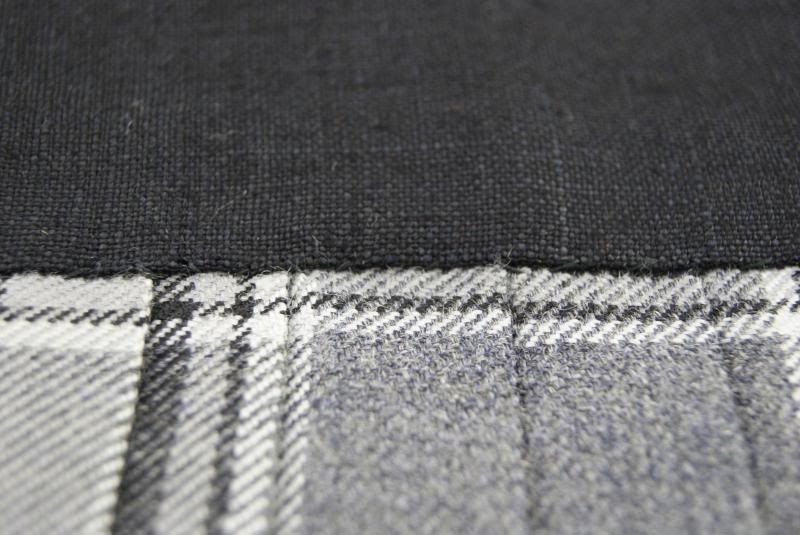
Here is the lining, fully sewn into the kilt

After that, we add the hole for the strap to come through the kilt and the buckles to the outside of the kilt. Here's a closeup picture of the pleats, the buckles and a belt loop after the kilt has been pressed. Notice that you don't see any stitches on the pleats from outside of the kilt.
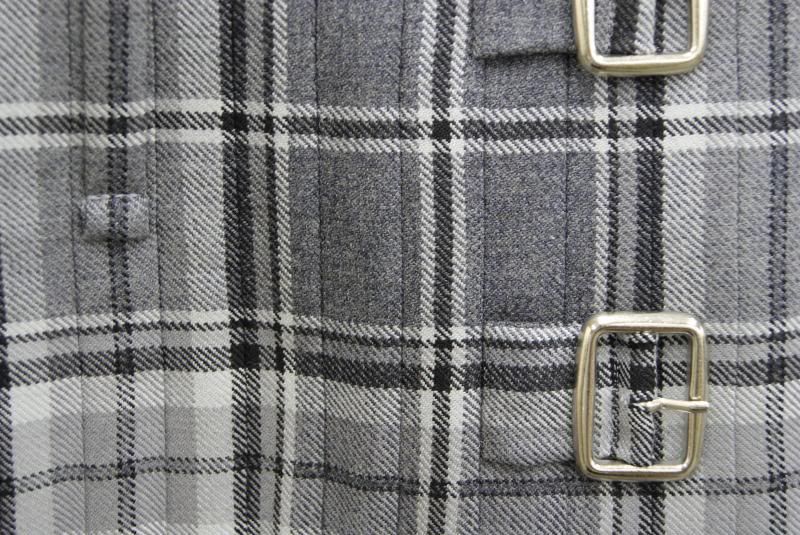
After the kilt is pressed, we're finished! Here's the kilt ready to be picked up by the customer.
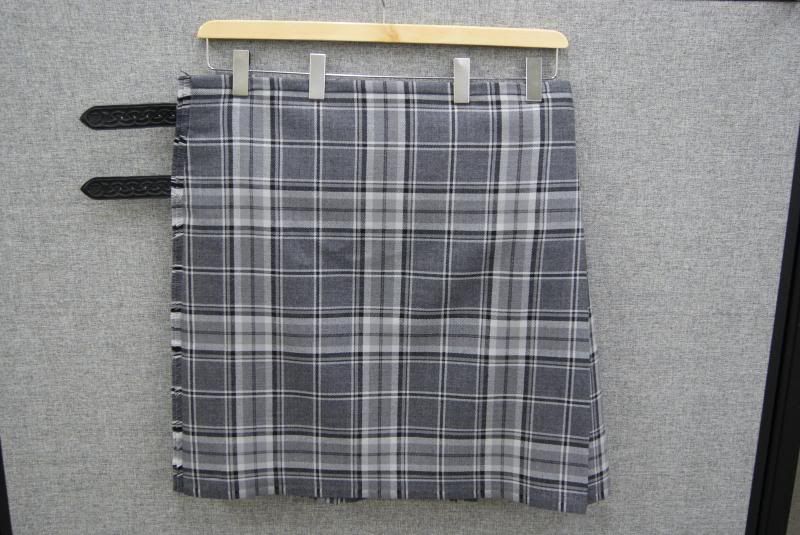
And the pleats...
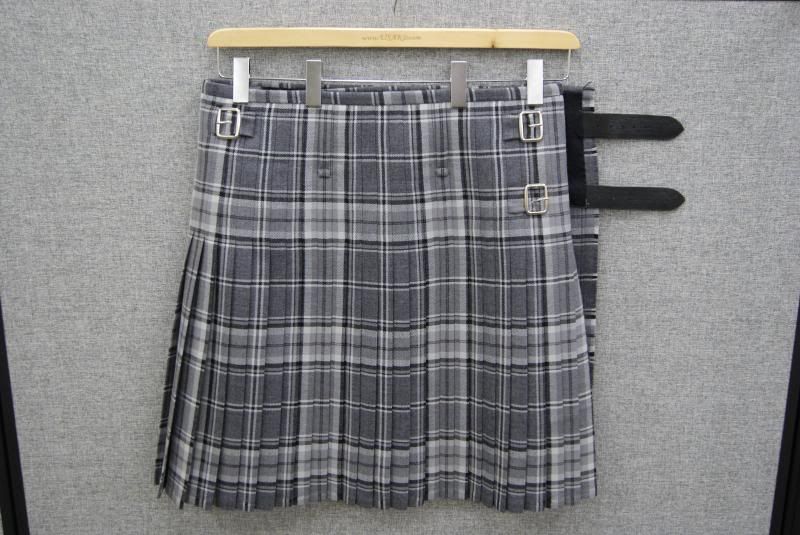
And now you know how our Premier 8 Yard Kilts are made. While they may look similar to our 5 Yard Wool, Semi Traditional, and Casual models there's a lot more effort and labor that goes into the construction of the Premier 8 Yard kilt that you don't see.
I hope these pictures helped to answer the question on why some kilts are more expensive than others. If you have any further questions, please feel free to post them below or email me at rocky@usakilts.com
Wednesday, May 15, 2013
Store Update Complete.
After a few long sawdust filled days, we were able to successfully finish our store update. Here are a few pictures of the new cherry wood finish fixtures / slatwall / etc.


Front Counters with Sgian Dubhs, Cuff Links, and Jewelry

Pewterware, Glassware and Scarves

Women's Coats, Dresses, etc.

Women's Coats, Dresses, etc.

Men's Shirts, Tweed Jackets, etc.


We hope you find yourself in the area with a bit of time to stop in and browse around and chat.
Subscribe to:
Posts (Atom)